


Yaxel Lendeborg played just eleven games of high school basketball. The road he’s walked to the NBA has been mired in struggles, determination, and multiple twists and turns.
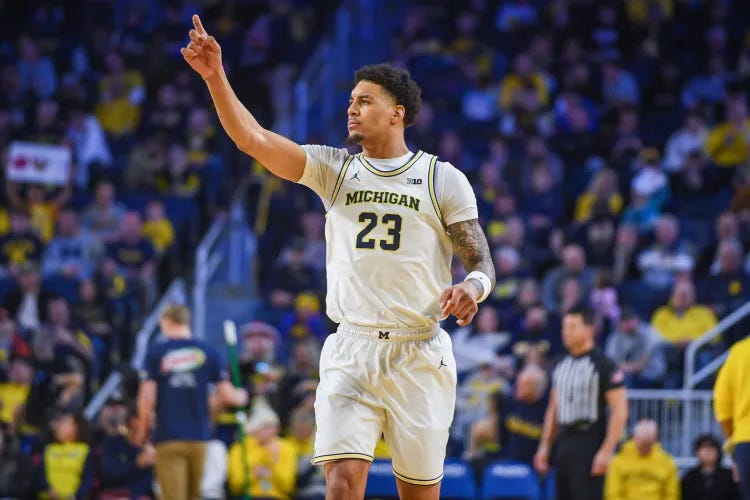
Cut from the high school squad as an underclassman for poor grades, Yaxel knew he needed to get his life on track. He put in the work, countless hours grinding in the gym alone, and focusing on making decisions that would benefit his future. Eventually, he cracked the roster for a second time, but still left Pennsauken High with barely a footprint in the sand.
From there: junior college, where he became the NJCAA's all-time leading rebounder; still, he grinded. Then UAB, where he produced a season only Larry Bird had ever matched, clearing 600 points, 400 rebounds, and 150 assists. But he wasn’t done. A year at the University of Michigan saw him win Big Ten Player of the Year, make consensus All-American, and hit a tournament game-winner on the way to a national title. Amazingly, Lendeborg played the final on a sprained MCL, a knee injury that can severely impact an athlete’s ability to take the court, let alone perform the standard needed to win. That says a lot about the man’s character and determination: further driven home by the quote "I will be on that floor,".
“I will be on that floor” summarises Yaxel’s pathway to the league; a path defined by grit, hustle, drive, and perseverance.
But while you can only admire the grit and determination of the man affectionately referred to as Yax, at the end of this long road walked, along twisted paths and roads less travelled, all the way up the Barclays Centre steps, is future NBA stardom even on the cards? Is a long career even assured?
History says, “don’t count on it.”
Age at draft related to flame-outs in the NBA
The Warriors are just one week removed from selecting Lendeborg in the 2026 NBA draft lottery. Yax entered draft night at 23 years, 8 months, and 24 days old.
But will be 24 years of age before the NBA season even starts.
Easily the oldest player taken in the first round, he is older than Brandin Podziemski, another Warriors first-round draft selection, who is entering his fourth year in the league. Yax is also a week older than Jonathan Kuminga, who the Warriors unceremoniously dumped to Atlanta before he even reached the age Yax is now, after taking him with the 7th pick in the 2021 Draft.
Yet, Yax was pick 11 in a class widely dubbed as one of the strongest and deepest we’ve seen.
People say "24-year-old rookie" quietly in professional basketball. Like they're reading a terminal diagnosis, and with reason. Age relative to production is one of the strongest indicators of a bust, or at the very least, a lower upside prospect; draft evaluators have. Names like Chris Duarte, the 13th pick of the 2021 draft, and Melvin Ely, the 12th pick in 2002, come to mind, both of whom checked into the league at age 24 before promptly busting back out.
Even new recruits aged 23 have historically performed poorly: Michael Olowakandi, 1st overall pick in 1998 at 23 years of age and two months; Rafael Arujo, 8th pick in 2004 at 23 years and 10 months, and ex-Warriors pick 6 of Ekpe Udoh in 2010 at the ripe old age of 23 years and 1 month. All of them strewn across the metaphorical minefield of the great age dilemma, careers in tatters.
The list goes on: Al Thornton, Pick 14; Carlos Rogers, Pick 11; Trajan Langdon, Pick 11; Shaun Respert, Pick 8; Courtney Alexander, Pick 13. The lottery is filled with older prospects whose brightest shine came in the form of a fireball crashing back to earth as they, one after another, flamed out spectacularly.
The table below shows the clear and negative relationship between older age and positive career outcomes in the NBA
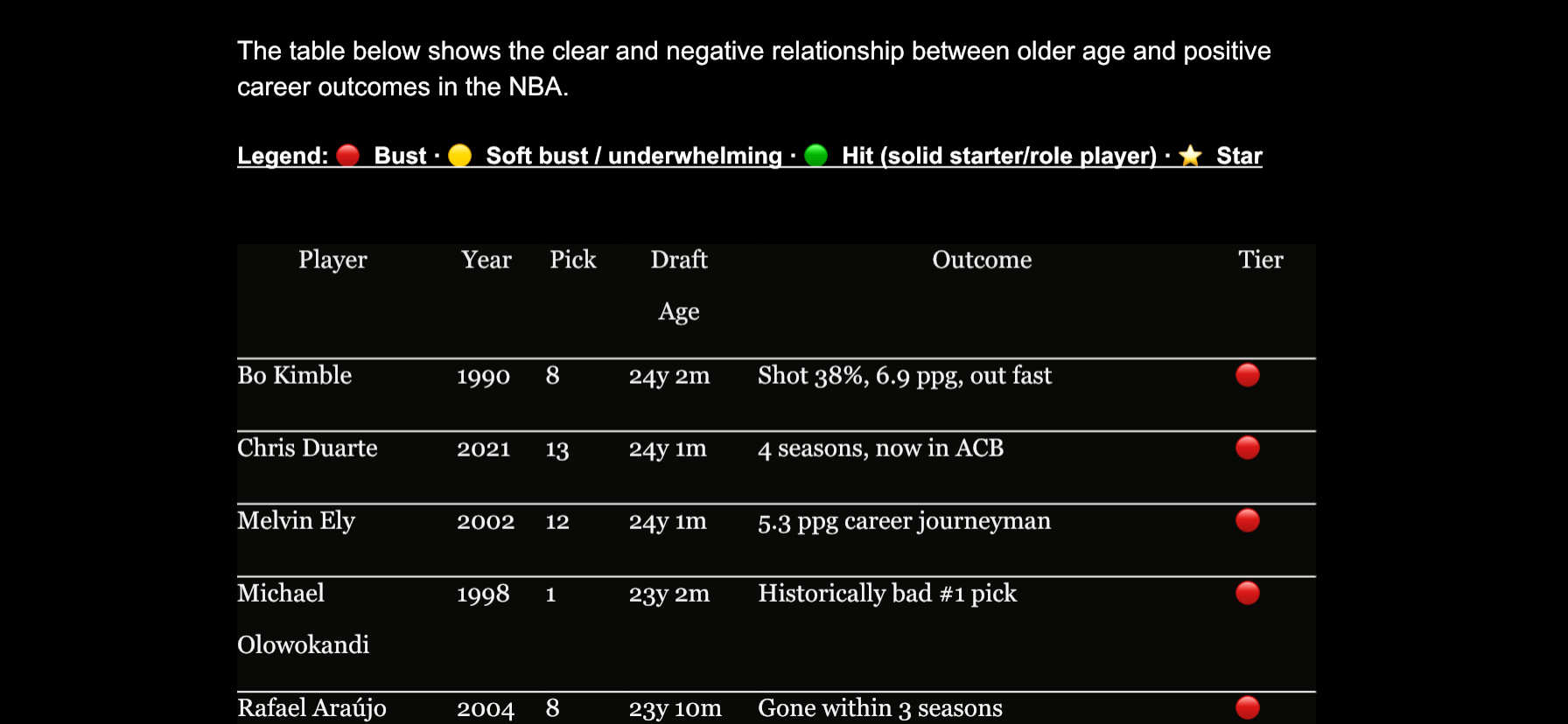
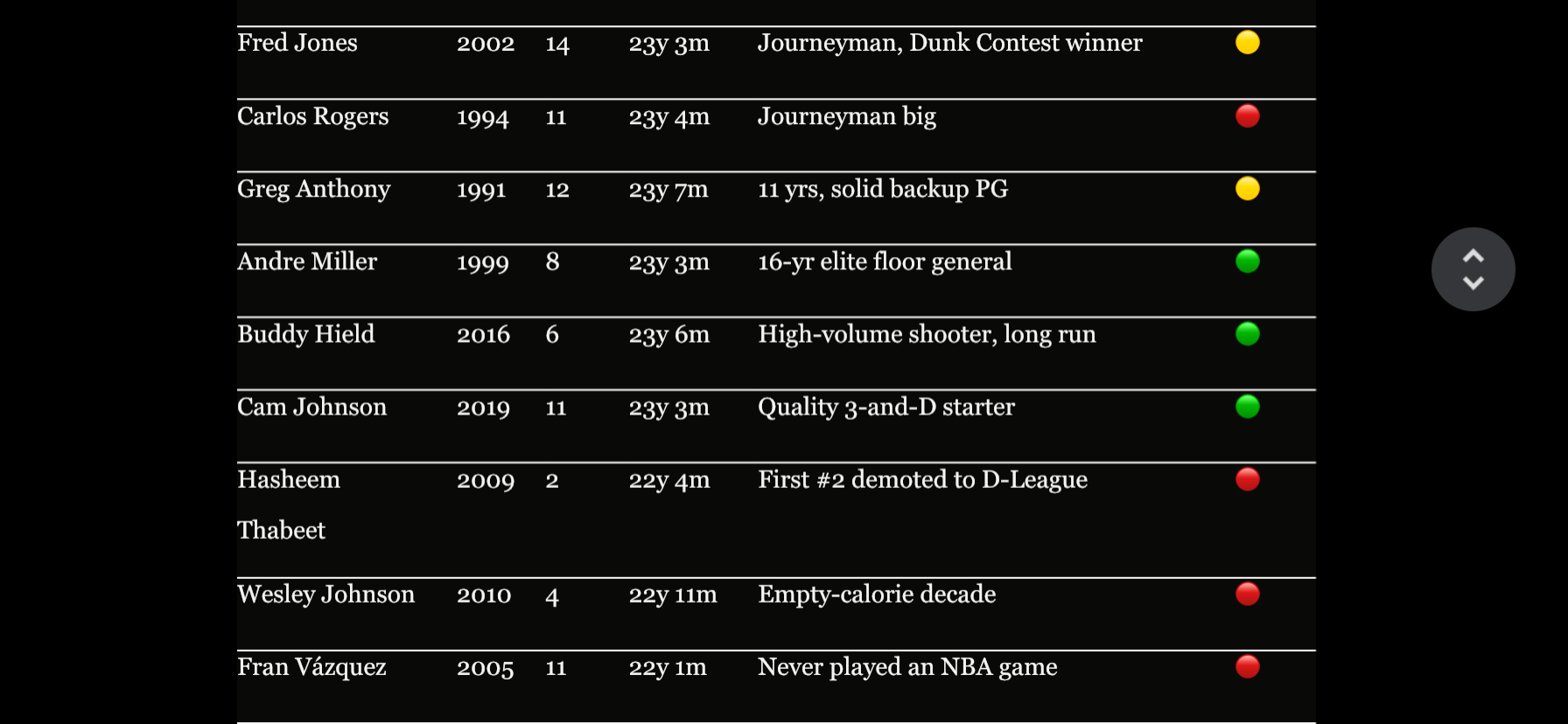
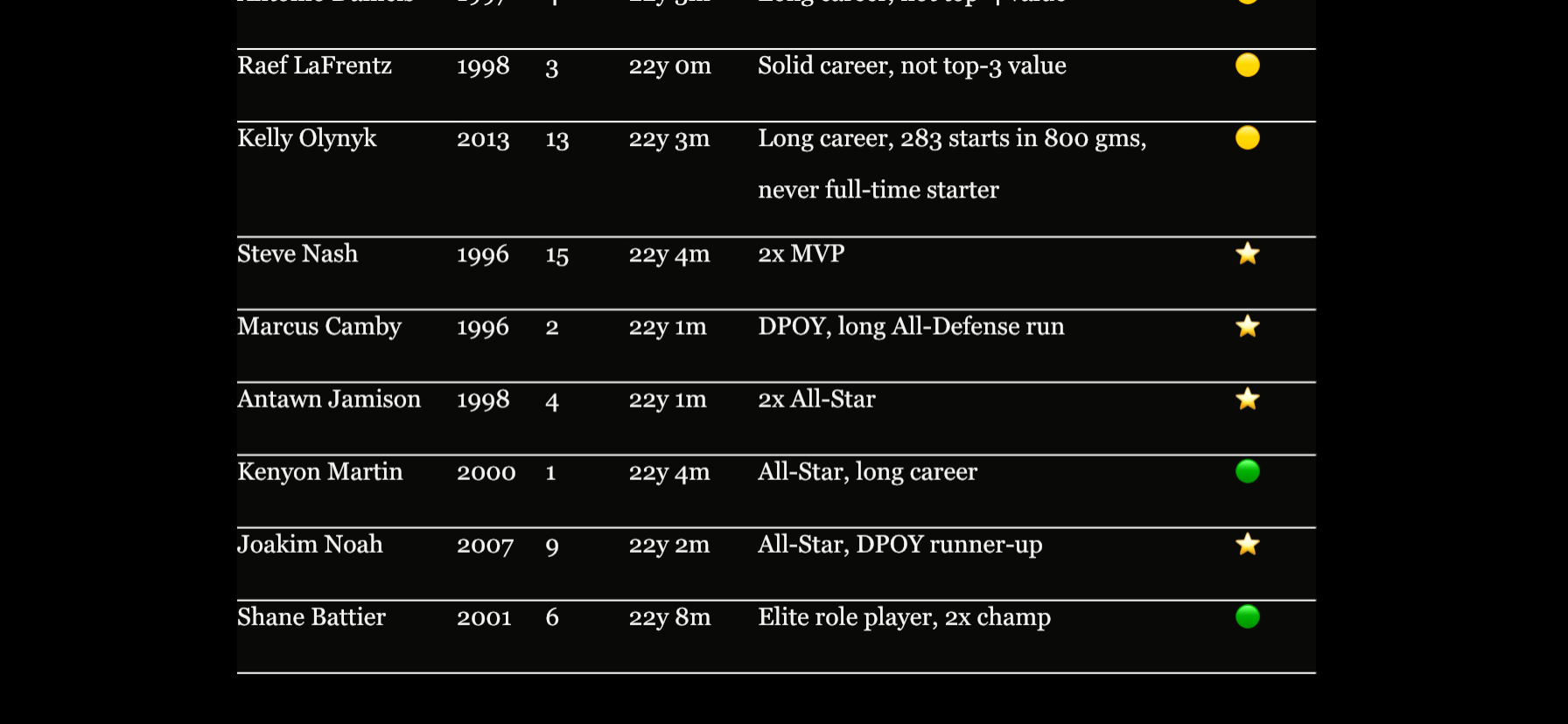
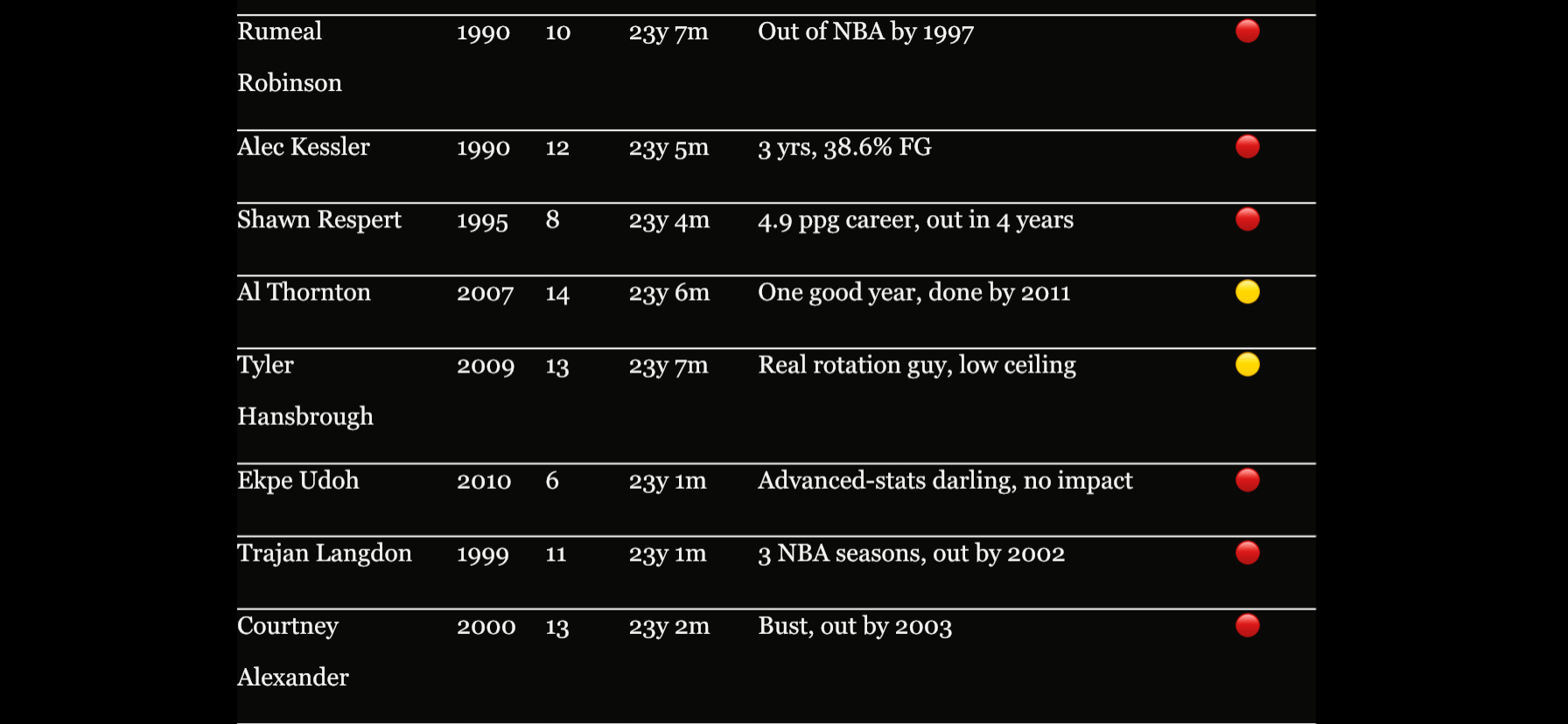
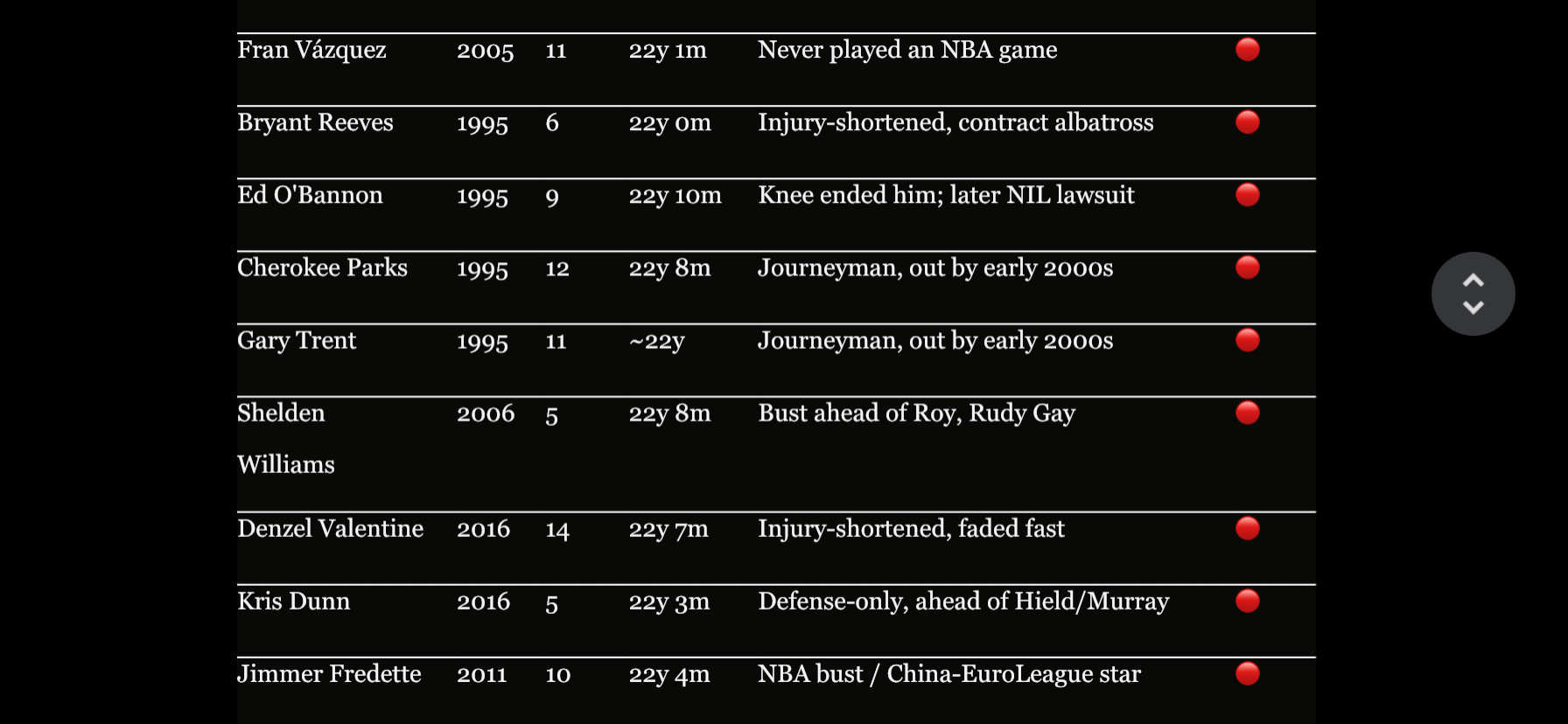
As we can verify from the merciless slew of red dots, the prospects for older players entering the league are akin to those faced by Katniss in the Hunger Games. That is to say, the odds are not in their favour.
Will Yaxel suffer the same fate?? Is this yet another Warriors pick we will look back on in a few years' time and ponder if a more established player would have been a wiser choice? As the stats show, this isn’t a question about stardom. It’s about being a viable player in the toughest league on the planet.
Age at draft limits success in the NBA
For older draft picks who don’t flame out, does a sterling career in the NBA await?
I researched players taken in the lottery at various age cutoffs and tried to determine how many “star” level players we’ve seen at each juncture. What I found is consistent with the data connecting older draft picks to early career death.
Drafted at 24: nobody. Not a short list, nobody. The math barely allows it, and the few cases we have seen are the Chris Duarte’s and Melvin Ely’s of the world; it’s rare for even a 4-year college career to end with a player across the borderline of 24, and the few that classified flamed out in diabolical fashion.
Even at 23, while sample size gives us more scope for an outlier, the pickings are still incredibly slim. The best player taken at 23 in thirty-five years is Sam Cassell, one All-Star Game, three rings riding shotgun, fifteen very good seasons, but a name a casual fan may struggle to place, let alone know the peak of.
Behind him sit Josh Howard, Andre Miller, Malcolm Brogdon and Buddy Hield. Useful players for sure, but not ones you would tend to be excited about spending a lottery pick on.
Players drafted at 22 see a sizable uptick in all-star ceilings, but even at 22, the lone MVP winner in 35 long seasons of basketball was Steve Nash, an MVP winner who doesn’t get the respect he deserves. There are a handful of All-NBA players in here, with names like Pascal Siakam, Marc Gasol, Draymond Green and Derrick White, but even those names were rarely lottery picks, and for every success story, there’s a litany of bodies in their wake.
Why draft age is a reliable red flag for NBA survival and stardom
The Athletic once counted every player drafted at 22 or older across a fifteen-year window and found roughly 3 reliable starters out of thirty. This backs my thesis that draft age is one of the most reliable red flags we can obtain easily in the draft process.
The reason is as mundane as it is easy to decipher: a 23-year-old averaging 25 in college is doing it against teenagers. Projection models never ask how good you are; they ask how good you are for your age and how much runway you still have to improve your game and expand your skill set. Age generally buys floor and charges a tax on ceiling.
Lendeborg may not have been drafted at 24, but he was about as close to it as anybody has ever been, and he will be 24 by the time he sees an opening tip.
There is exactly one patron saint of the 24-year-old rookie: David Robinson, who debuted in November 1989 at 24, won Rookie of the Year in a landslide, and went on to an MVP, ten All-Star games and two rings.
But Robinson is a trap. He debuted at 24 but was drafted at 21, first overall in 1987, touted as the next generational center; Robinson is an exception forged in happenstance, as he spent his two years between being drafted and entering the league serving in the Navy.
Robinson was so good, he was picked 1st overall two years before he would be able to debut, and the Spurs were happy, and correct to make that selection anyway; however, Robinson wasn’t debuting at 24 because he wasn’t ready yet; he simply felt he had a duty to his country he had to uphold, and the Spurs felt he was worth the wait. The question was never when you show up. It's how old you were on the night you were good enough to get taken.
By every rule the league has operated under, that should be the crux of the evaluation.
However, in the last few years something has changed in college that may alter the options for prospective players whose biological clocks are ticking
For thirty-five years, there were only two doors into old-rookie status: rejected young, or drafted young and delayed. Every player taken at 23 walked through the first. The league looked at Cassell, Howard and Brogdon at 21 and 22 and said not yet, you need another year, and their draft age recorded that rejection, like the rings of an aged oak.
But Lendenborg's path was different.
He declared for the 2025 draft after a strong junior campaign, and teams wanted him. He was projected to go late in the first round, a draft slot worth around $14 million over four years.
The league said yes. Yaxel Lendeborg said no. Michigan put roughly $5 million on the table for one more collegiate season, more than the rookie deal would have paid, and Yaxel Lendeborg decided to briefly forgo the NBA in favor of the money and title shot. The decision paid dividends, as Yaxel indeed did go on to win the NCAA title, and returned to the draft a year older with his stock on an upward curve, eschewing prior wisdom that an extra year would drop, not boost his stock.
As such, Yaxel’s collegiate route has proffered a third door for a prospect to walk through. Old because nobody would take him? No. Old because a team parked him somewhere? No. Old because staying paid better than leaving.
That is a third door, and it did not exist five years ago. Cassell could not have walked through it in 1992 if he'd wanted to, because no version of college basketball could outbid an NBA contract.
Lendeborg's 23-and-nine-months is not the same measurement as Cassell's 23-and-seven.
Part of Cassell's number was a rejection by league evaluators, while part of Lendeborg's is a cheque proffered by new NIL regulations.
He isn't an outlier, either. This past season was billed as the year of teenage phenoms, and still it was the upperclassmen running the sport instead. Michigan won the title with a frontcourt of transfers. Players are staying; they're being paid seven figures to do so, and the prospect pool is aging as a result; we just saw multiple players who were likely first-round locks go back to college instead, such as Florida’s Thomas Haugh and UConn’s Braylon Mullins, both figured to go closer to the lottery than the second round.
The influence of NIL is real, and it may threaten to dissect the most surefire tell we have as draft analysts. A 24-year-old body is a 24-year-old body; that much will always remain true, and the development of a guy who is 22, 24 will always be viewed as more in the rearview mirror than a 18, 19-year-old. However, no longer can we assume that an older prospect wasn’t “good enough” to be taken earlier. Now, it’s no longer NBA teams telling these kids no at every turn; at half it’s now the kids themselves looking NBA front offices in the eyes and saying, “No, I’m going to stay put.”
Remove the year-to-year rejection, and consolidate a $5 million reason to stay, and we may be able to render the thirty-year “red flag” on older prospects partially obsolete. Every player in that three-of-thirty sample given by the Athletic was drafted before the money changed. The dataset that damns Lendeborg comes from a trend that may no longer exist.
So does that mean we will begin to see a wave of over-23-year-olds taken at the time of the draft blossom into future stardom?
If you ask me, the conventional wisdom still wins more often than it loses, at least as it pertains to star calibre upside. If these guys were truly good enough to go in the lotto and parlay that into a long and fruitful NBA career, the compensation and promise of NIL offers would not hold quite the same weight over their decision-making. However, the route for fewer busts and more useful, long-career role players coming from these late selections could be opening up in a major way.
If I were taking bets, I’d happily take the line that says Lendeborg is a very good role player who never makes an All-Star team, which at pick 11, for a team trying to win with Steph Curry right now, is a good outcome rather than a consolation prize, and even that is an improvement from how I’d have viewed a prospect at such an advanced age a few years ago, where I would routinely state that draft age has bust written all over it.
The strongest indicator of the age indictment was never the body; it was the rejection baked into the number. Prospects have never had the incentive to look NBA Evaluators in the eyes and say No, I’m going to play in college instead, and Yaxel Lendeborg is the first lottery pick with a real case to show us the strongest indicator we’ve had, draft age, is becoming outdated.
So, do I think Yaxel Lendeborg has any runway left to become an all-star, or all-star-adjacent impact player? I’m not convinced, but Golden State just spent the 11th pick to find out.
By Liam Cannold, Lead Draft Analyst for Point Made Basketball
Works Cited
Basketball-Reference. "Al Thornton Stats, Height, Weight, Position, Draft Status." Basketball-Reference.com. https://www.basketball-reference.com/players/t/thornal01.html
Basketball-Reference. "David Robinson Stats, Height, Weight, Position, Draft Status." Basketball-Reference.com. https://www.basketball-reference.com/players/r/robinda01.html
Basketball-Reference. "Melvin Ely Stats, Height, Weight, Position, Draft Status." Basketball-Reference.com. https://www.basketball-reference.com/players/e/elyme01.html
Basketball-Reference. "Mateen Cleaves Stats, Height, Weight, Position, Draft Status." Basketball-Reference.com. https://www.basketball-reference.com/players/c/cleavma01.html
Basketball-Reference. "Rumeal Robinson Stats, Height, Weight, Position, Draft Status." Basketball-Reference.com. https://www.basketball-reference.com/players/r/robinru01.html
Basketball-Reference. "Tyler Hansbrough Stats, Height, Weight, Position, Draft Status." Basketball-Reference.com. https://www.basketball-reference.com/players/h/hansbty01.html
Basketball-Reference. "Jimmer Fredette Stats, Height, Weight, Position, Draft Status." Basketball-Reference.com. https://www.basketball-reference.com/players/f/fredeji01.html
Basketball-Reference. "Yaxel Lendeborg Stats, Height, Weight, Position, Draft Status." Basketball-Reference.com. https://www.basketball-reference.com/players/l/lendeya01.html
Basketball-Reference. "NBA Draft Index — Latest and Historical NBA Drafts." Basketball-Reference.com. https://www.basketball-reference.com/draft/
Basketball-Reference. "2007 NBA Draft." Basketball-Reference.com. https://www.basketball-reference.com/draft/NBA_2007.html
Basketball-Reference. "2010 NBA Draft." Basketball-Reference.com. https://www.basketball-reference.com/draft/NBA_2010.html
Bleacher Report. "The 50 Most Overhyped Prospects in NBA History." Bleacher Report, June 7, 2018. https://bleacherreport.com/articles/503347-the-50-most-overhyped-prospects-in-nba-history
ESPN. "Worst Lottery Picks in NBA Draft History." ESPN Page 2, June 26, 2008. https://www.espn.com/espn/page2/story?page=worstpicks%2F080625
ESPN. "1999 NBA Draft: Trajan Langdon." ESPN.com, 1999 (archived). https://www.espn.com/nba/draft99/players/profiles/langdon_trajan.html
Grantland. "The Ultimate Crapshoot." Grantland.com. https://grantland.com/features/nba-draft-crapshoot-repick-1995/
Nerkar, Santul. "NBA Teams Love Young Lottery Picks. These 3 'Old' Players Might Change Their Minds." FiveThirtyEight, July 28, 2021. https://fivethirtyeight.com/features/nba-teams-love-young-lottery-picks-these-3-old-players-might-change-their-minds/
NBA.com. "Legends Profile: David Robinson." NBA.com, September 23, 2022. https://www.nba.com/news/history-nba-legend-david-robinson
NBA Communications. "2026 NBA Draft Notes." NBA.com, June 2026. https://pr.nba.com/2026-nba-draft-notes
NBADraft.net. "Yaxel Lendeborg — Player Profile." NBADraft.net. https://www.nbadraft.net/players/yaxel-lendeborg/
NBADraft.net. "Tyler Hansbrough — Player Profile." NBADraft.net. https://www.nbadraft.net/players/tyler-hansbrough/
NBC Sports Bay Area. "Warriors Pick Yaxel Lendeborg's Age Puts NBA Draft Norms Into Perspective as Oldest in First Round." NBC Sports Bay Area, June 2026. https://www.nbcsportsbayarea.com/nba/golden-state-warriors/yaxel-lendeborg-rookie-nba-draft-age/1945569/
SportCLT. "The Fallacy of Older Draft Prospects Being Pro-Ready." SportCLT.com, May 27, 2026. https://www.sportclt.com/p/the-fallacy-of-older-draft-prospects
The Draft Review. "Melvin Ely — 2002 NBA Draft Player Profile." TheDraftReview.com. https://www.thedraftreview.com/nba-players/2002-nba-draft/melvin-ely
Vorkunov, Mike. Draft-age analysis of players selected at 22 or older, The Athletic, 2024. As cited in NBC Sports Bay Area, "Warriors Pick Yaxel Lendeborg's Age Puts NBA Draft Norms Into Perspective," June 2026. https://www.nbcsportsbayarea.com/nba/golden-state-warriors/yaxel-lendeborg-rookie-nba-draft-age/1945569/
Wikipedia. "Alec Kessler." Wikipedia. https://en.wikipedia.org/wiki/Alec_Kessler
Wikipedia. "David Robinson." Wikipedia. https://en.wikipedia.org/wiki/David_Robinson
Wikipedia. "Mateen Cleaves." Wikipedia. https://en.wikipedia.org/wiki/Mateen_Cleaves
Wikipedia. "Melvin Ely." Wikipedia. https://en.wikipedia.org/wiki/Melvin_Ely
Wikipedia. "Shawn Respert." Wikipedia. https://en.wikipedia.org/wiki/Shawn_Respert
Wikipedia. "Tyler Hansbrough." Wikipedia. https://en.wikipedia.org/wiki/Tyler_Hansbrough
Wikipedia. "Jimmer Fredette." Wikipedia. https://en.wikipedia.org/wiki/Jimmer_Fredette
Wikipedia. "Yaxel Lendeborg." Wikipedia. https://en.wikipedia.org/wiki/Yaxel_Lendeborg
Great insight. The NIL will produce changes that we can't forsee for sure, including better players in the 2nd round once the inventory of draftees is replenished.